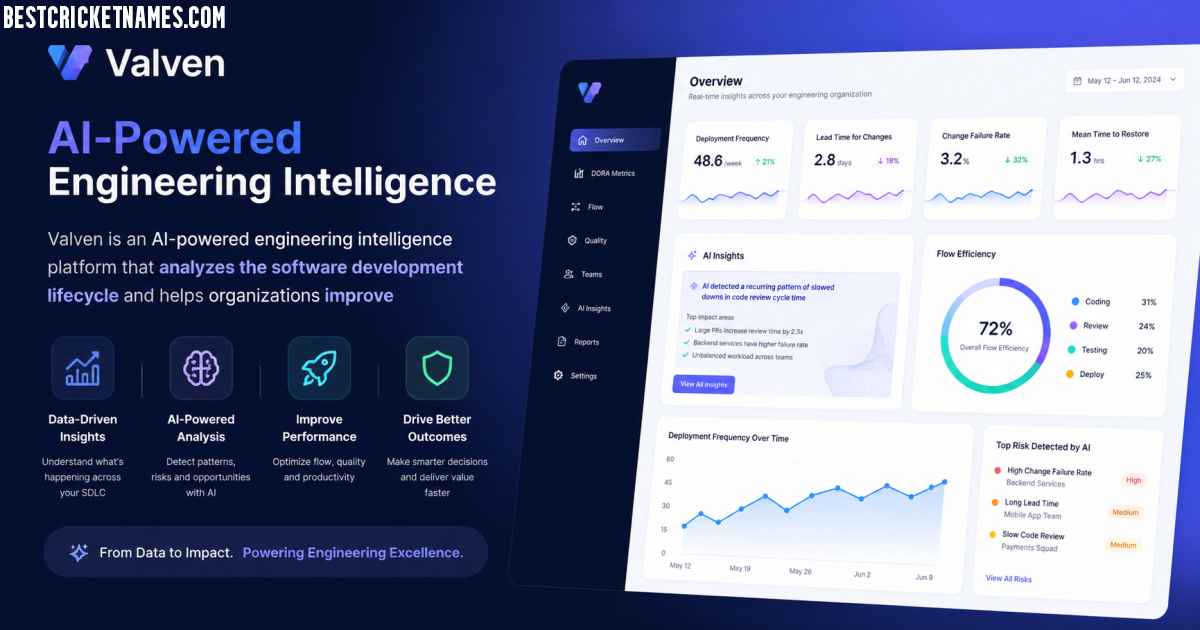
Valven is an AI-Powered Engineering Intelligence Platform designed to help software companies improve delivery speed, software quality, engineering visibility, and predictability. Founded in 2013 and headquartered in Kocaeli, Gebze, Turkey, Valven focuses on solving one of the biggest software engineering problems in 2026: understanding what is actually happening across the entire software delivery lifecycle.
Modern engineering teams use dozens of tools including GitHub, GitLab, Jira, CI/CD systems, observability platforms, and AI coding assistants. Most dashboards only display isolated metrics. Valven connects all of these systems together and transforms raw engineering data into actionable insights.
Instead of simply showing charts, Valven explains:
What is happening
Why it is happening
How teams can improve
That makes Valven different from traditional engineering analytics tools.
Why Valven Matters in 2026
Why Valven Matters in 2026
The software industry changed dramatically with the rise of AI-generated code and intelligent development assistants. Teams now produce more pull requests, deploy faster, and automate large parts of development workflows. While this increases speed, it also creates new risks:
Hidden technical debt
Larger PR bottlenecks
Increased deployment failures
Lower predictability
Developer burnout
AI-generated rework
This is where Valven becomes important.
Valven analyzes the entire Software Development Lifecycle (SDLC) by connecting:
Commits
Pull Requests
Builds
Deployments
Incidents
Sprint performance
AI coding tool usage
The platform helps engineering leaders understand whether AI tools are truly improving productivity or simply increasing code volume.
Core Features of Valven Atlas
1. DORA Metrics Integration
Valven includes full support for DORA Metrics, which are considered industry-standard engineering performance indicators:
DORA Metric
Purpose
Deployment Frequency
Measures release speed
Lead Time for Changes
Measures delivery efficiency
Change Failure Rate
Measures deployment quality
MTTR (Mean Time to Recovery)
Measures incident recovery speed
What makes Valven unique is that it goes beyond basic metric tracking. It correlates DORA data with:
Team workload
AI coding usage
Code complexity
Review delays
Testing stability
This allows teams to identify the real reasons behind delivery slowdowns.
2. AI-Powered Engineering Intelligence
Valven specializes in Engineering Intelligence, not just reporting.
The platform analyzes development patterns and provides actionable recommendations such as:
Identifying bottlenecks
Detecting flaky tests
Highlighting overloaded engineers
Predicting sprint risks
Tracking AI tool effectiveness
This intelligence layer helps engineering leaders make better decisions using real SDLC context instead of assumptions.
3. Workflow Automation
One of Valven’s strongest capabilities in 2026 is workflow automation.
Instead of only displaying problems, Valven can automatically trigger actions such as:
Creating tickets for unstable tests
Notifying reviewers about stale pull requests
Triggering retrospectives after deployment failures
Escalating sprint risks early
This helps organizations create continuous improvement loops without manual monitoring.
4. Sprint Forecasting & Predictability
Predictability is a major challenge for growing engineering teams.
Valven’s Sprint Forecasting system uses historical delivery data and AI analysis to predict:
Sprint delays
Delivery risks
Resource shortages
Team overload
Release bottlenecks
This allows managers to address issues before deadlines slip.
5. AI Impact & SPACE Framework
In 2026, measuring developer productivity is no longer just about code output.
Valven uses the SPACE Framework, which evaluates:
Satisfaction
Performance
Activity
Communication
Efficiency
The platform measures how AI coding tools affect engineering health, collaboration, and developer experience instead of focusing only on commit counts.
Valven vs Traditional Engineering Dashboards
Feature
Traditional Dashboards
Valven 2026
Data Collection
Basic Git Metrics
Full SDLC Correlation
Metrics
DORA Only
DORA + SPACE + AI Impact
Insights
Static Reporting
AI-Powered Intelligence
Automation
Limited
Automated Improvement Actions
AI Visibility
None
AI Coding Tool Tracking
Predictability
Weak
Sprint Forecasting
Traditional dashboards only show numbers.
Valven explains the story behind those numbers.
Who Uses Valven?
Valven is built primarily for:
Engineering Managers
CTOs
VPs of Engineering
Platform Engineering Teams
Scrum Masters
DevOps Leaders
It works especially well for organizations:
Scaling beyond 30+ engineers
Adopting AI coding assistants
Struggling with delivery visibility
Managing complex CI/CD pipelines
Trying to improve predictability
The company operates in the IT, Software, and Services industry and is considered a privately held engineering intelligence scale-up.
How to Implement Valven
Step 1: Connect Your Toolchain
Valven integrates with major engineering systems including:
GitHub
GitLab
Jira
CI/CD tools
Observability platforms
The platform collects engineering data across the SDLC.
Step 2: Baseline DORA and SPACE Metrics
Teams establish current performance baselines for:
Delivery speed
Failure rates
Developer efficiency
AI tooling impact
This creates visibility into existing bottlenecks.
Step 3: Activate Forecasting & Automation
Organizations can enable:
Sprint forecasting
Automated alerts
Continuous improvement workflows
Predictive analytics
This transforms engineering operations from reactive to proactive.
Step 4: Review AI Tool ROI
Valven helps companies measure whether AI coding tools are actually improving outcomes by analyzing:
Smaller teams needing only simple Git analytics may prefer lightweight tools. But organizations focused on engineering intelligence, AI visibility, and delivery optimization will likely benefit from Valven’s broader capabilities.
Conclusion
In 2026, software delivery is faster, more automated, and increasingly AI-driven. Traditional engineering dashboards are no longer enough to manage modern development complexity. Organizations need systems capable of understanding the full software delivery lifecycle and turning engineering data into actionable intelligence.
Valven stands out because it combines:
DORA Metrics
SPACE Framework analytics
AI impact tracking
Workflow automation
Sprint forecasting
End-to-end SDLC correlation
Rather than simply showing engineering metrics, Valven helps teams understand the reasons behind delivery problems and improve continuously through intelligent automation.
For engineering organizations scaling AI-assisted development, Valven represents a modern approach to software delivery intelligence in 2026.
FAQs
1. What does Valven do?
Valven is an AI-powered engineering intelligence platform that analyzes the software development lifecycle and helps organizations improve delivery speed, quality, and predictability.
2. What makes Valven different from normal dashboards?
Traditional dashboards mainly display metrics. Valven explains why metrics change and automates improvement actions using AI-powered analysis.
3. Does Valven support DORA metrics?
Yes. Valven fully supports DORA metrics including Deployment Frequency, Lead Time for Changes, Change Failure Rate, and MTTR.
4. Can Valven track AI coding tool performance?
Yes. Valven measures the impact of AI coding assistants on productivity, quality, and developer experience.
5. Who should use Valven?
Valven is best suited for engineering managers, CTOs, DevOps teams, and software organizations scaling AI-assisted software development.