
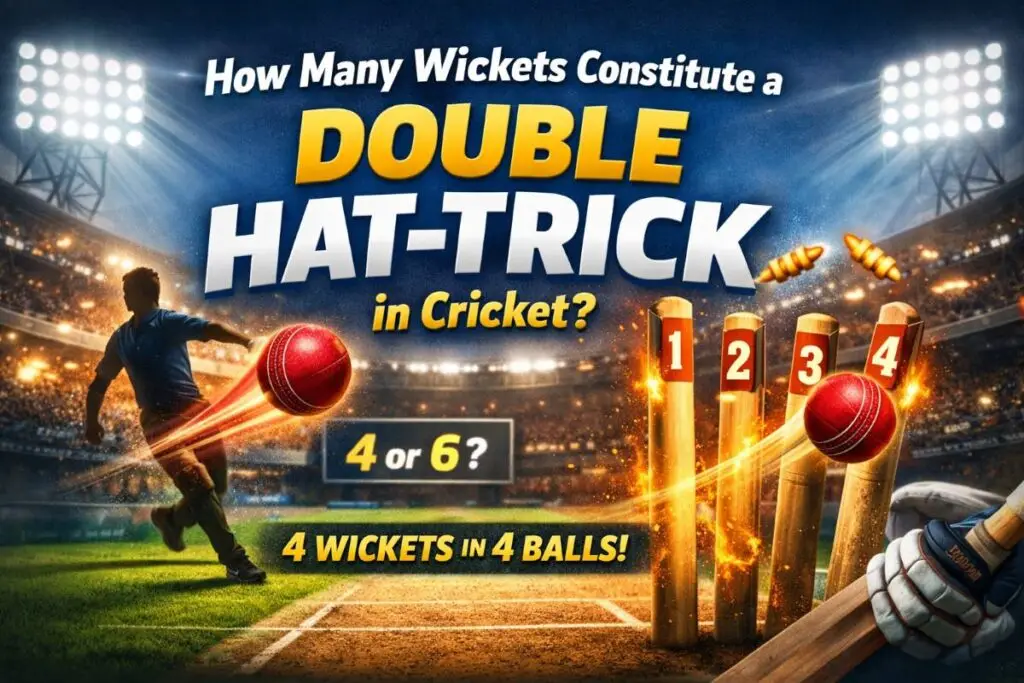
A double hat-trick in cricket means 4 wickets in 4 consecutive legal deliveries by the same bowler. Despite the name, it does not mean 6 wickets. The term is widely used but not officially defined in cricket laws.
Also Read: What is Cricket? Rules, Formats, History & How to Play (Beginner Guide)
What Is a Hat-Trick in Cricket?
A hat-trick in cricket occurs when a bowler takes three wickets in three consecutive balls. It is one of the most celebrated achievements in the sport because it shows consistency, control, and the ability to perform under pressure.
Interestingly, a hat-trick doesn’t have to happen in a single over. It can span across overs as long as:
- The deliveries are consecutive
- The same bowler delivers all balls
Key Facts About Hat-Tricks
- First recorded hat-trick: Fred Spofforth (1879)
- Common in all formats: Tests, ODIs, T20s
- Famous Indian examples: Chetan Sharma (1987 World Cup), Jasprit Bumrah (Test cricket)
For Indian fans, hat-tricks are often unforgettable IPL moments where a match suddenly shifts in just a few balls.
Also Read: IPL Points Table 2024 | Complete Standings, Team Rankings, NRR Analysis & Playoff Scenario
What Is a Double Hat-Trick?
A double hat-trick in cricket is when a bowler takes:
- 4 wickets
- In 4 consecutive legal deliveries
- All credited to the same bowler
This is essentially an extension of a hat-trick. Instead of stopping at three wickets, the bowler continues the streak for one more delivery.
Important Clarification
Many people assume:
- “Double hat-trick” = 6 wickets ❌
- Actual meaning = 4 wickets ✔
This confusion comes from the word “double,” but in cricket terminology, it simply means going one step further, not doubling the number. Also check out: In Which Country Was the Googly Invented? Origin, History & Complete Cricket Guide
Hat-Trick vs Double Hat-Trick: Key Difference
| Feature | Hat-Trick | Double Hat-Trick |
| Wickets | 3 wickets | 4 wickets |
| Balls | 3 balls | 4 balls |
| Difficulty | Rare | Extremely rare |
| Recognition | Officially recognized | Informal but accepted |
Key Insight
The jump from 3 wickets to 4 may seem small, but in cricket, it’s massive. Each additional wicket increases the difficulty exponentially.
Simple Ball-by-Ball Example of a Double Hat-Trick
Understanding this visually makes everything clearer.
Regular Hat-Trick (3 in 3)
- Ball 1 → Bowled
- Ball 2 → LBW
- Ball 3 → Caught
Result: Hat-trick
Double Hat-Trick (4 in 4 / 6 in 6 Debate)
- Ball 1 → Bowled
- Ball 2 → Caught
- Ball 3 → LBW
- Ball 4 → Bowled
Result: Double hat-trick
6 in 6 Debate
- 6 wickets in 6 balls is sometimes called a “perfect over.”
- It is not officially termed a double hat-trick
Also Read: Who Scored a Century in Just 3 Overs? The Truth Behind Don Bradman’s Legendary Record
Official Rules and Technical Conditions of a Double Hat-Trick
What Counts as a Legal Delivery
Only valid deliveries count toward a double hat-trick:
Valid deliveries:
- Standard legal balls
Invalid deliveries:
- No-balls
- Wides
If an invalid delivery occurs, the sequence breaks.
Types of Dismissals That Count
Only dismissals credited to the bowler count:
- Bowled
- LBW (Leg Before Wicket)
- Caught
- Stumped
- Hit wicket
Can It Span Overs or Innings?
| Condition | Allowed? |
| Across overs | Yes |
| Across innings | No |
Example:
- Over 1 → Last 2 balls = wickets
- Over 2 → First 2 balls = wickets
✔ Still a double hat-trick
Common Misconceptions About Double Hat-Tricks
Myth 1: A Double Hat-Trick Means Six Wickets
- ❌ Incorrect
- ✔ Correct: 4 wickets in 4 balls
Myth 2: Run-Outs Count
- ❌ Incorrect
- ✔ Only bowler-attributed wickets count
Myth 3: It Must Happen in One Over
- ❌ Incorrect
- ✔ Can span overs
Myth 4: It Is an Official ICC Category
- ❌ Incorrect
- ✔ Not defined in MCC laws, but widely used
Most Notable Players with Double Hat-Tricks (4 in 4 Balls)
Lasith Malinga (Sri Lanka)
- Match: 2007 ODI World Cup vs South Africa
- Famous for yorkers
- Nearly turned the match single-handedly
Rashid Khan (Afghanistan)
- First T20I double hat-trick (2019)
- Known for variations and control
Curtis Campher (Ireland)
- T20 World Cup 2021
- Took 4 wickets in 4 balls under pressure
Jason Holder (West Indies)
- T20I vs England (2022)
- Achieved in the final over, a match-winning performance
Other Notable and Associate-Level Examples
Waseem Yaqoob (Lesotho)
- ICC qualifiers
- Demonstrates the growth of cricket in associate nations
Hernan Fennell (Argentina)
- T20I achievement (2024)
- Shows the global expansion of cricket talent
Format-Wise Breakdown of Double Hat-Tricks
Test Cricket
- Extremely rare
- Defensive batting reduces chances
One-Day Internationals (ODIs)
- Moderate possibility
- Malinga’s 2007 example
T20 and T20I Cricket
- Highest probability
- Aggressive batting increases wickets
Key Insight for Indian Fans
- IPL is the most likely place for a future double hat-trick
Ball-by-Ball Analysis of Famous Double Hat-Tricks
Lasith Malinga vs South Africa, 2007 ODI
- Bowled → Bowled → Caught → Bowled
- Reduced a strong batting lineup instantly
Rashid Khan vs Ireland, 2019 T20I
- LBW → Bowled → Bowled → LBW
- Showcased variation mastery
Curtis Campher vs Netherlands, 2021 T20 World Cup
- LBW → Caught → Bowled → LBW
- Changed the match momentum
Full List of International Double Hat-Trick Instances
| Year | Player | Country | Format | Opponent |
| 2007 | Lasith Malinga | Sri Lanka | ODI | South Africa |
| 2019 | Rashid Khan | Afghanistan | T20I | Ireland |
| 2021 | Curtis Campher | Ireland | T20I | Netherlands |
| 2022 | Jason Holder | West Indies | T20I | England |
| 2024 | Waseem Yaqoob | Lesotho | T20I | Mali |
| 2024 | Hernan Fennell | Argentina | T20I | Cayman Islands |
Also Read: Cricket Equipment Name List with Images – A Complete Guide
Notable Domestic and Franchise Examples
IPL (Indian Premier League)
- No confirmed double hat-trick yet
- Several near misses
BBL (Big Bash League)
- Close streaks observed
- High-scoring format
PSL (Pakistan Super League)
- Similar patterns to IPL
- Frequent wicket clusters
Domestic and Club Cricket
- More frequent due to skill gaps
- Common in gully cricket (India)
How Rare Is a Double Hat-Trick in Cricket?
Historical Frequency
- Only a handful globally
- Far rarer than hat-tricks
Factors Affecting Chances
- Pitch conditions
- Bowling skill
- Batter pressure
- Match situation
Why a Double Hat-Trick Is So Difficult
A double hat-trick requires:
- Perfect execution across four deliveries
- Facing new batters, each ball
- Maintaining focus under pressure
Even world-class bowlers struggle to achieve this consistently.
Related Rare Bowling Feats in Cricket
| Feat | Description |
| Hat-Trick | 3 wickets in 3 balls |
| Double Hat-Trick | 4 wickets in 4 balls |
| Five in Five | Extremely rare |
| Perfect Over | 6 wickets in 6 balls |
Why Fans Love Double Hat-Tricks
- Sudden match turnarounds
- High drama
- Memorable moments
- Viral IPL-style excitement
In India, such moments quickly trend on social media and become part of cricket folklore.
Conclusion: How Many Wickets Constitute a Double Hat-Trick?
To sum it up clearly:
A double hat-trick in cricket consists of 4 wickets in 4 consecutive legal deliveries.
While the term may sound confusing, its meaning is straightforward once understood. It remains one of the rarest and most exciting achievements in cricket, combining skill, pressure, and perfect timing.
And for Indian fans, whether in IPL or gully cricket, the day we see one live will be unforgettable.
FAQs About Double Hat-Tricks in Cricket
How many wickets make a double hat-trick?
A double hat-trick requires 4 wickets in 4 consecutive legal deliveries.
Is a double hat-trick 4 or 6 wickets?
It is 4 wickets, not 6.
Is a double hat-trick an official term?
No, it is not defined in official cricket laws.
Can a run-out count?
No, only bowler-attributed dismissals count.
Can it span overs or innings?
Overs: Yes
Innings: No
Which format has the most occurrences?
T20 cricket has the highest chances due to aggressive batting.