
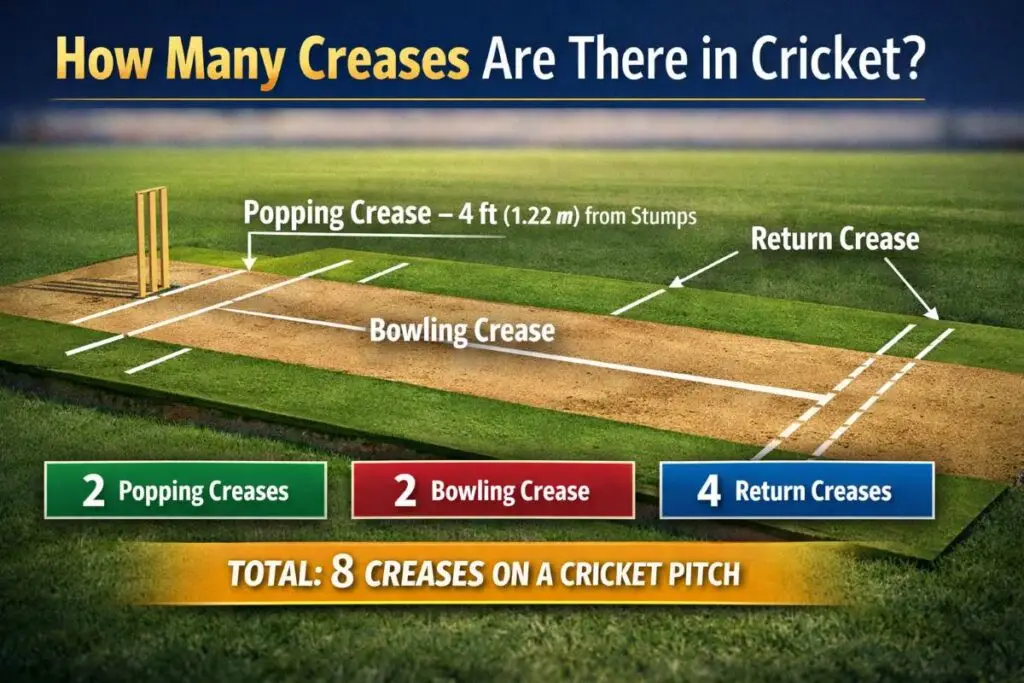
There are 8 creases on a cricket pitch. These include:
- 2 popping creases
- 2 bowling creases
- 4 return creases
Each type appears at both ends of the pitch, so 3 types × 2 ends = 8 total creases. These cricket pitch creases define batting safety, bowling legality, and umpire decisions, making them essential to how cricket is played.
Also Read: In Which Country Was the Googly Invented? Origin, History & Complete Cricket Guide
What Is a Crease in Cricket?
If you strip cricket down to its basics, a crease in cricket is simply a painted white line on the pitch that acts as a boundary line for players. But in practice, it’s much more than just a marking.
- It defines a safe zone for batters
- It marks the legal zone for bowlers
- It gives umpires a reference point for decisions
In official terms, creases are governed under the Laws of Cricket, and they determine whether a player is “in” or “out” of their ground.
Think of creases as the invisible rules made visible. Without them, concepts like run-outs, no-balls, and stumpings would be impossible to judge.
Types of Creases in Cricket
There are three main types of creases in cricket, repeated at both ends of the pitch.
Overview of Cricket Crease Types
| Crease Type | Position | Main Purpose |
| Popping Crease | In front of stumps | Batter safety, run-out decisions |
| Bowling Crease | Under the stumps | Defines delivery line |
| Return Crease | Vertical lines on the sides | Controls bowler’s movement |
Key Structure:
- 3 types of creases
- Present at both ends
- Total = 8 creases in cricket
This structure is why many people confuse the number of creases because they see types instead of total lines.
Popping Crease in Cricket
The popping crease in cricket is arguably the most important line on the pitch.
Key Facts:
- Located 4 feet (1.22 m) in front of the stumps
- Runs parallel to the bowling crease
- Used to determine:
- Run-outs
- Stumpings
- Front-foot no-balls
Why It Matters:
- A batter must have their bat grounded behind the popping crease to be safe
- It acts as the primary safety line for batters
In real matches, this line often decides outcomes, sometimes by just a fraction of an inch.
Bowling Crease in Cricket
The bowling crease in cricket is the line where the stumps are positioned.
Also Read: How Many Wickets Constitute a Double Hat-Trick in Cricket? (4 or 6 Explained)
Key Facts:
- Runs directly through the stumps
- Length: 8 ft 8 in (2.64 m)
- Marks the starting point of delivery
Important Clarification:
Many beginners assume this line determines no-balls, but that’s not entirely correct.
- Front-foot no-balls are judged using the popping crease
- The bowling crease mainly defines alignment and position
It plays a foundational role in pitch structure rather than direct decision-making.
Return Crease in Cricket
The return crease in cricket is often overlooked but crucial for bowlers.
Key Facts:
- Vertical lines on both sides of the stumps
- 2 per end → 4 total
- Positioned 4 ft 4 in from the center line
Purpose:
- Controls the bowler’s back foot placement
- Prevents bowling from unfair angles
Rule:
👉 If the bowler’s back foot touches or crosses the return crease → No-ball
This ensures fairness and consistency in bowling angles.
Visual Breakdown of All Creases
Understanding the cricket pitch layout with creases becomes easier when you visualize it step by step.
At One End:
- 1 Popping crease
- 1 Bowling crease
- 2 Return creases
👉 Total: 4 creases per end
Full Pitch:
- Same structure at both ends
👉 Total: 8 creases on the cricket pitch
Cricket Crease Layout Table
| Crease Type | Quantity | Position | Role |
| Popping Crease | 2 | In front of stumps | Safety line |
| Bowling Crease | 2 | Under stumps | Delivery base |
| Return Crease | 4 | Vertical sides | Bowler control |
How Each Crease Impacts the Game
Creases directly influence gameplay and decisions.
Batters
- Must stay inside the popping crease to be safe
- Used in:
- Run-outs
- Stumpings
- Every inch matters during close plays
Bowlers
- Must follow:
- Front foot rule (popping crease)
- Back foot rule (return crease)
- Violations result in:
- No-ball
- Extra runs and a possible free hit
Umpires
- Use creases as decision reference lines
- Judge:
- Run-outs
- Stumpings
- No-balls
Modern cricket also uses DRS and replay technology to assist these crease decisions.
Also Read: Who Scored a Century in Just 3 Overs? The Truth Behind Don Bradman’s Legendary Record
Real-Life Examples of Crease Decisions
MS Dhoni’s Lightning Run-Out of Ross Taylor (2016)
A perfect example of crease awareness, where Dhoni removed the bails before the bat crossed the popping crease.
Ben Stokes Overstepping in a Test Match
A wicket was overturned because of a front-foot no-ball, showing how strict crease rules are.
World Cup 2019 Final – Every Inch Mattered
Multiple decisions were made using slow-motion replays to check whether players were inside the crease.
Conclusion
Understanding how many creases are in cricket isn’t just about counting lines; it’s about understanding how the game works.
- There are 8 creases
- There are 3 types
- Each crease plays a specific role in gameplay
These simple white lines control everything from safety to legality to match decisions.
Once you understand them, you don’t just watch cricket, you actually start to read the game. Also check out the Cricket Equipment Name List with Images – A Complete Guide
FAQs
How many creases are there in cricket?
There are 8 creases in total, four at each end of the pitch.
What are the 4 creases in cricket?
At one end, there are:
1 popping crease
1 bowling crease
2 return creases
What is the popping crease used for?
It determines:
Run-outs
Stumpings
No-ball decisions
Where is the bowling crease located?
It is located directly under the stumps at both ends of the pitch.
Why does the bowler stay behind the line?
To avoid a no-ball, ensure a legal delivery.
Can a batsman be safe if the bat is on the crease?
Only if the bat is grounded behind the line, not just touching it in the air.
How wide is the return crease?
Return creases are positioned about 4 ft 4 in from the center line.
What happens if a bowler crosses the return crease?
It results in a no-ball due to illegal positioning.
Do crease rules change in T20s or Tests?
No, crease rules remain the same across all formats
Do they paint the creases before every match?
Yes, creases are freshly marked before each match for clarity.
How do umpires check no-balls at the crease?
They use visual judgment and replay technology (DRS).
Can you get a 5 in cricket?
Yes, through overthrows or running multiple runs.
Why are there 6 balls in an over in cricket?
It’s the standard rule in modern cricket formats.
Can you get 2 wickets in 1 ball?
Yes, in rare cases like run-out + obstruction scenarios.