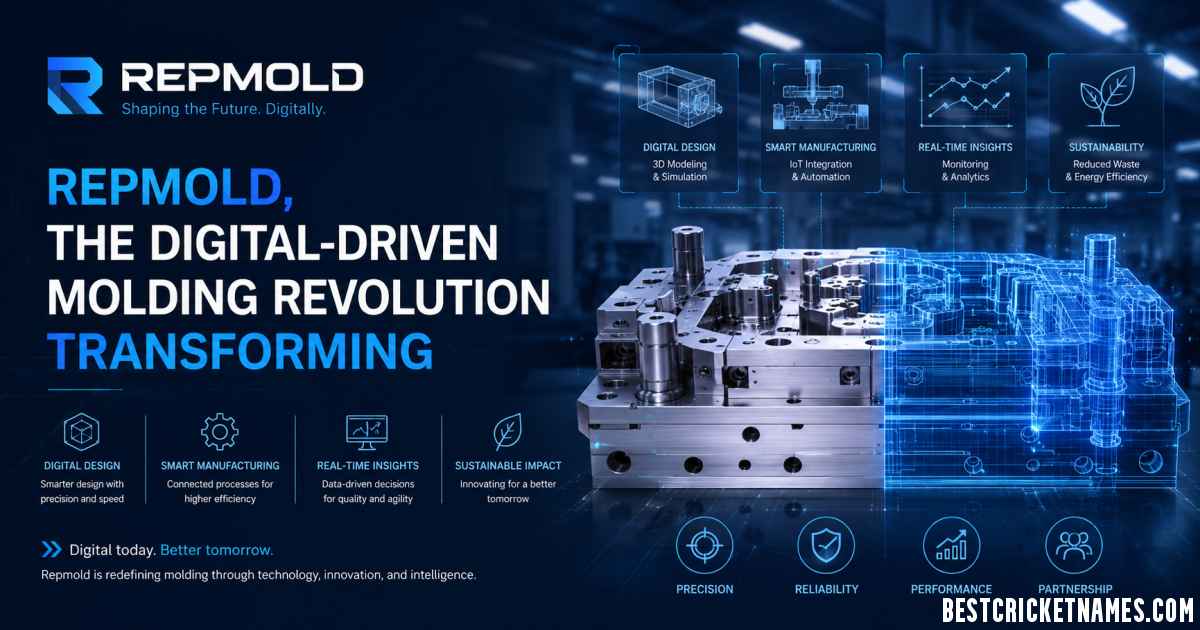
The Digital-Driven Molding Revolution Transforming Manufacturing: repmold 2026.
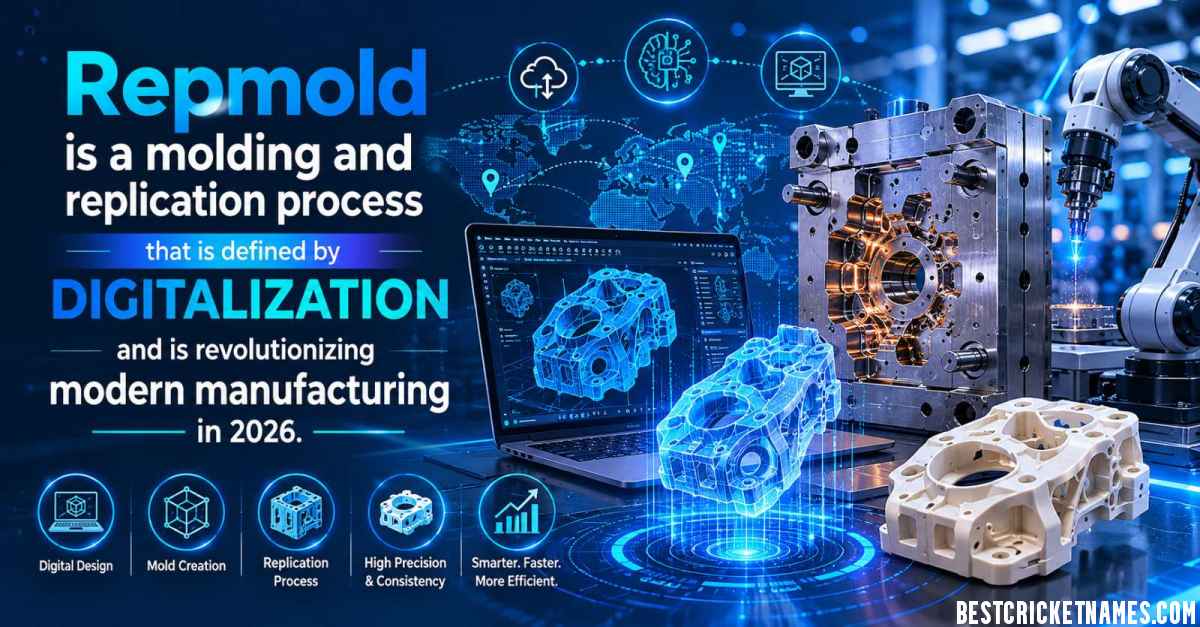
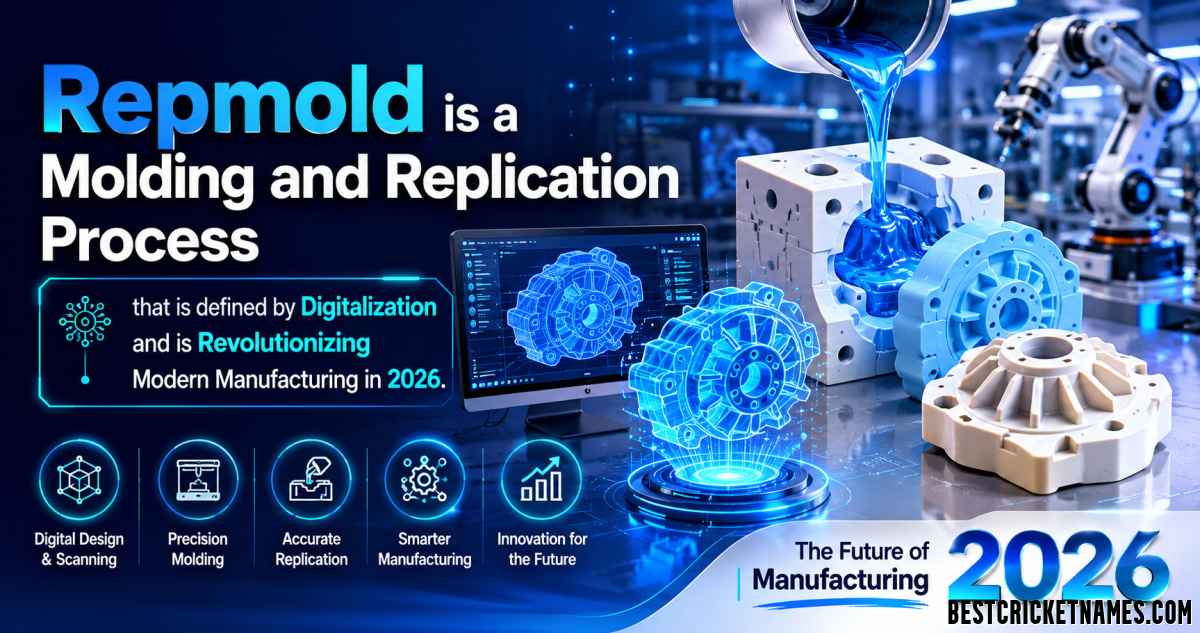
Repmold is a molding and replication process that is defined by digitalization and is revolutionizing modern manufacturing in 2026. The combination of computer-aided design (CAD), 3D printing, automation, artificial intelligence (AI), and adaptive molds allows Rep Mold to design, test, and manufacture components in an unprecedented speed, precision and cost. Unlike weeks or months for traditional steel tooling and $50,000+ costs, Rep Mold provides high fidelity parts within days with soft tooling and industrial grade resins. Rempld’s Rep Mold is a tool, but more than that, it’s a connection between digital design and physical manufacturing, a link between the technologies of Industry 4.0.
1. What Is Repmold? Definition & Core Concept
The intended meaning of the Repmold.
What Is Repmold?
The core concept behind repmold is a hybrid production approach that takes digital “replication” techniques and rapid molding to make high fidelity parts in a matter of moments as opposed to the lengthy process of conventional tooling. The name is derived from “replication” and “molding”.
The engineers use the tooling method called Rep Mold to make the temporary or “soft” tooling, avoiding the use of hardened steel molds that can take three months to build. It enables the production of 50-5,000 parts, using industrial grade resins that can be made in properties similar to end-use plastics like ABS or Polycarbonate.
The advantages of repmold vs traditional molding.
Factor
Traditional Steel Tooling
Repmold
Lead Time
Weeks to months
Days
Cost
$50,000+ per mold
Fraction of the cost
Flexibility
Stiff — design changes = huge loss of money
Adaptive — repeat without penalty
Best For
Mass production 100k+
Rapid prototyping, short 50-5,000 parts.
Material
Hardened steel
The materials used include epoxy, silicone, composite resins, and 3D-printed templates.
Key Insight: For most product designs, there will be at least three revisions during the first year of a product’s launch. When it comes to committing to a permanent mold too soon, every design change comes at a tremendous cost. repmold allows you to repeat, test and ship to early customers while your competitors wait for steel tools.
2. How Repmold Works: The Digital-to-Physical Process
Repmold’s operation is based on a digital to physical workflow, which integrates additive and subtractive manufacturing:
Step 1: Digital Design & Master Pattern
Repmold starts with the digital modelling, typically using CAD software, to create the master part. The design is utilized to create a master pattern, which is done using 3D printing or CNC machining.
Step 2: Mold Creation & Replication.
The master is used to create the mold, which is typically made from epoxy, silicone or composite resin. The mold can be used to cast many identical parts to a high degree of accuracy when cured. The advanced technology involves 3D scanning, CNC machining, laser welding and thermal spraying in the repair and/or replication of molds.
Step 3: Production & Testing
This is a new or remodeled mold that is used in a production environment. Important is that it can process the cycle count, temperature, pressure and the material of the last production parts. This isn’t a prototype, it’s a benefit for Rep Mold.
Step 4 is the last but crucial step in the process of monitoring and optimizing continuously.
Repmold workflows are digital tracking of mold condition, so that downtime can be avoided because mold can be repaired or replaced before failure. Each production run gives feedback to make better molds. Continuous design, testing and reproduction ensures an economical production.
3. The core features & Technologies of Repmold.
Repmold combines the technologies of Industry 4.0 to offer speed, precision and sustainability:
CAD and AI ensures accuracy in design replication, with digital precision. Micron-level accurate molds are made with Computer-Aided Manufacturing (CAM) and real-time monitoring sensors.
Adaptive Molding: Flexible moulding which adjust to product requirements. High performance polymers, composite materials or even metal hybrid may be used.
Rapid Prototyping: Speeds up the testing and iteration process. From digital file to physical part – in days, not months.
Cost Efficient Scaling: helps minimize costs in mass production, and avoid eye-catching start-up costs of steel injection molding.
Smart Systems Integration: It seamlessly integrates with IoT devices and AI-driven automation. Utilizes digital twin models & cloud-based production management.
Chemical Recycling Tech: There are some Rep Mold systems that focus on chemical depolymerisation to reuse fabrics made from polyester and packaging materials with several layers as high quality raw materials.
Proprietary Material Formulation: A unique material formulation is used in some Rep Mold processes, offering the ability to cure faster without compromising strength, precision or finish.
5. Productivity and Sustainability in Repmold for 2026.
Repmold is revolutionizing the industry in several areas and is offering agile, sustainable production:
Industry
Repmold Applications
Benefit
Automotive
Creating prototypes of dashboards, housings, brackets
Use tests to design the test.
Aerospace & Defense
Lightweight, high-precision components
Accuracy, consistency, repeatability
Medical Devices
Custom housing, surgical guides, enclosures
A biocompatible resin and quick turn around.
Consumer Electronics
Casings, connectors, wearables
Mimic ABS/Polycarbonate properties
Packaging
Bottles, caps, containers
Short-run market testing
Industrial Equipment
Gaskets, seals, impellers
Minimize Lead-Time & cost
Today’s manufacturing environment is all about speed, accuracy and sustainability. The traditional mold-making process can be difficult to meet tight production times and keep pace with changing designs.
6. Repmold’s application in the modern manufacturing industry
Repmold’s application in the modern manufacturing industry
1. Speed & Agility
Repmold helps to overcome this impasse between slow 3D printing and costly steel tooling by providing a middle ground in speed. Traditional techniques – accurate molds in days instead of months.
2. Cost Reduction
Reduces steel tooling costs of $50,000 and more. Minimizes waste and reduces production costs. There is less waste and less energy is consumed with digital models.
The ability to meet design expectations while managing risk.
In the first year, most product designs is undergoing a minimum of three changes. With Repmold you can experiment without a huge loss of money. Don’t rush into taking a permanent mold.
4. Accuracy & Consistency
Guarantees the uniformity of product size. Vigorously tested parts using industrial grade resins. No variation between productions using smart digital mapping.
5. Sustainability
Promotes environmental responsibility by reducing waste. Recycled materials are utilized more. Minimizes material, time and cost. Completes the circular economy.
6. Scalability for SMEs
Enables small businesses and innovators to experiment with ideas and get to market sooner. It’s composed of individual modules, so it may be used by any size business or big corporations.
In this section, you will learn about the transition from the traditional manufacturing to Repmold and the potential applications of Industry 4.0.
The Evolution to Repmold
Engines were used for the first time and machines were powered by steam.The first Industrial Revolution: Manual tools and steam-powered machines.
The second revolution is the electricity-powered mass production.The second revolution is the mass production revolution powered by electricity.
Third Revolution: Automation and robotics
Fourth Revolution: Digital transformation with AI, IoT and smart manufacturing
Repmold is located in the middle of all Industry 4.0 technologies, offering customers fast prototyping, cost savings and smarter workflows.
Can Repmold take the place of conventional mould making?
Not a complete track. Even though it speeds up and enhances the process, there are some companies who might prefer the traditional way of running 100k+ runs. Rep Mold is NOT always for mass production.
7. Restrictions & Issues that arise in Adopting Repmold
Although repmold is the game-changer, there is a need to plan its use:
Material Limitations: The cycle-life of soft tooling is less than that of steel tooling. Best for 50 to 5000 – not millions.
Trained Personnel: Expensive and requires trained people to establish complex digital systems.
Application fit: Not suitable for very high volume or very high temperature / pressure parts.
Quality Control: Needs digital monitoring, and predictive maintenance to avoid downtime.
The disadvantages of using such tools are minimal compared to the benefits: quicker time-to-market, product quality, a more environmentally friendly manufacturing process, and data-based decisions.
8. The Future of Repmold: 2026 and Beyond
Repmold is changing the way smart digital manufacturing is done by combining AI, digital twin models, eco-friendly materials, and cloud-based production management. With the arrival of 2025 and the future, Rep Mold isn’t just a tool for making things, it’s a game-changer!
2026 Trends
Automated Intelligence & Digital Twins: Optimisation loop of each production run which further feeds into future molds.
Chemical recycling and integration of the concept of the chemical recycling is increasing in sustainability.
Modular, scalable solutions make accessibility an appealing option for smaller businesses and innovators.
Material Innovation: Proprietary formulations for faster curing, but without diminishing strength.
Repmold’s growth is linked with the growing trend toward flexible and environmentally friendly production methods. Faster, more accurate and with only a fraction of the waste are the three attributes that businesses can create, test and make when producing goods.
A list of commonly asked questions and answers about Repmold.
Simply put, what is repmold?
Repmold is a hybrid production method of digital replication and rapid molding which produces high fidelity parts with soft tooling rather than costly steel molds.
2. What is the speed of repmold compared to the traditional moulding?
Rep Mold can produce accurate molds in days vs weeks or months for steel tooling.
What are the applications of reMold?
Automotive, aerospace, healthcare, electronics, packaging and consumer goods. Any industry that requires quick prototyping and/or short-run production.
4. Is repmold sustainable?
Yes. Less wastage, more recovery and reduced energy usage with digital models. Reduces waste of material.
5. Is Rep Mold an alternative for steel injection molding?
Not all the way. It’s best for 50-5,000 parts. Steel can still be used for 100k+ runs. Rep Mold can be used to make iterations before going to steel.
Conclusion
Repmold is precision, efficiency and adaptability for manufacturing in 2026. It connects the world of digital design and physical manufacture and addresses the fundamental dilemma of the modern manufacturing process of either taking a long time to prototype or spending a lot of money in tooling.
Adaptive molds, rapid prototyping and sustainability are just some of the ways AI makes it possible for businesses of all sizes to innovate, test and scale faster than ever. In an era where speed and sustainability are paramount in the industries, Rep Mold is shaping the future of manufacturing with precision mold technology.