

Delta Flight DL275 Diverted LAX: If there’s any aviation safety incident of the past few years that has been in the news, it’s the diversion of the Delta, LAX aircraft.One of the more talked about aviation incidents of the past couple of years is the diversion of the Delta LAX flight. A Delta Flight from Detroit Metropolitan Wayne County Airport (DTW) to Tokyo Haneda Airport (HND) diverted to Los Angeles International Airport (LAX) on 28 May 2025 after a problem with the engine anti-ice system. There were 287 people, including 12 crew, on board the aircraft, none of whom was injured upon its safe landing.
You’ll wonder what is Delta Flight DL275 after reading this.
Routes, aircraft and normal operations.
Delta Flight DL275 is a long haul international flight service that operates between Tokyo and the United States. The flight normally goes between:
- Detroit Metropolitan Wayne County Airport (DTW) – United States.
- It is in Tokyo Haneda Airport (HND), Japan.The airport is located in Tokyo, Japan (HND).
This trans-Pacific route passes over the North Pacific and typically takes about 13 hours. The aircraft typically used is the modern wide-body Airbus A350-900, which is a long-range international carryer jet. It is airliner engineered by Rolls-Royce Trent XWB-engine, which are very efficient and advanced in safety technology.
Aircraft Details: N508DN
The aircraft reported for the incident was N508DN flying at FL380, some 620nm southwest of Anchorage.
The following is a chronology of DL275 Diversion to LAX.
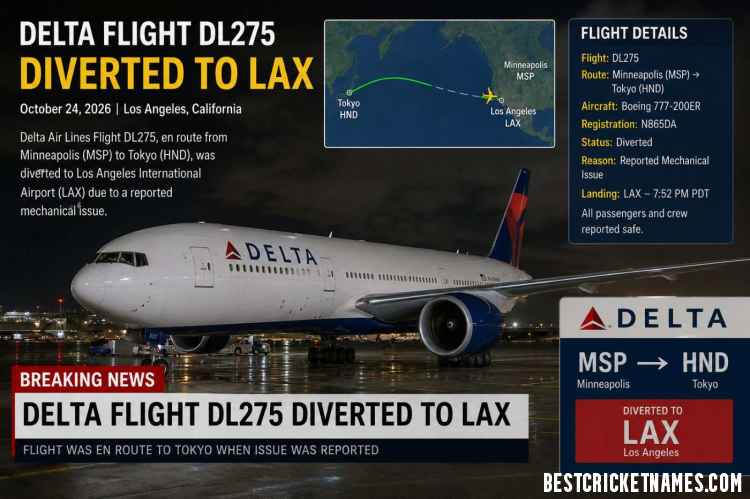
All was well right after takeoff. The plane ascended into its cruising altitude and started its flight over the pacific ocean. The flight crew, however, discovered a problem with the engine anti-ice system while at about 38,000 feet.
Due to this concern, the pilots opted to divert given their duty to safety first. The plane turned away and flew towards Los Angeles International Airport (LAX).
Key Flight Data
- Passengers: 287 passengers + 12 crew members aboard
- Spans 4, 5, and 8 levels.Accommodates 42 seats in the space of business class and 245 seats in economy class.
- Landing: Aircraft landed in good fashion about 5.5 hours after the diversion had been made on Runway 06R.
- Ground time: Average of about 18.5 hours for idle airframes before returning to service.
The plane landed without any incident at LAX with no injuries among the passengers or crew. The diversions started to get worldwide publicity via the web as Delta Flight DL275 Diverted LAX.
Why or How Did Delta Flight DL275 Divert? The explanation and warning of an anti-ice system failure.
Due to failure of the engine anti-ice system, the diversion was triggered. The anti-ice system keeps internal engine parts from icing over when flying in certain high altitude conditions over cold regions (like the North Pacific) or in freezing temperatures during ground operations.
Technical Root Cause
A chain of failures in the anti-ice system of the valve actuators was identified via technical analysis. Failure started with Variance in valve position six hours before the take-off, then moved to reduced flow during in flight, finally leading to systems failures over the Pacific Ocean. The initial cause was premature wear in the valve actuator mechanism; this has since been corrected by Rolls-Royce with modifications to the maintenance procedures.
Data from the incident indicated that 50% of the airflow was restricted, that valve responses had slowed and that 25% of the bleed air pressure had been lost, resulting in an inability to provide heated airflow of any type to the critical areas. It was made all the more dangerous due to the ambient temperature (as low as -67°F) at which the aircraft cruised.
When ice occurs it may cause engine damage or loss of performance. If this was not working, this flight could have been more dangerous to continue it.
Why LAX? How to select the safest diversion airport.How to select the safe (airport for diversion).
It has been decided that the location of LAX will be used because it provides better maintenance facilities for the Airbus A350 and Rolls-Royce engines. Geographically Anchorage was closer but LAX departmentalises 24/7 with Rolls-Royce specialists and extensive parts stock and has major Delta hub facilities.
Some considerations for choosing LAX:
- The length of the runways and their ability for the large aircraft such as the A350
- Access to user support and maintenance.
- The passenger service element which includes the rebook and hotel options,
- The presence of air lines for efficiency in their operations.
In closer spots, such as Alaska the full tools for A350 were not present. LAX was perfect, and reduced timings for fixes. Specialized parts may have been delayed by 24 to 48 hours and limited passenger rebooking choices have been available were Anchorage to have been a destination.
The resolution will reflect the Perspective of the Passenger Experience and Delta’s Response.
It was a normal day in the cabin without incident, and the crew behaved professionally. No emergency was declared, no turbulence and no visual indications of danger.
After Landing at LAX
- Anti-ice system – a problem that Delta’s Maintenance staff identified and addressed.
- On passenger care, the travellers were given a place to stay, food to eat and even were re-billed to other flights.
- Rebooking: Some headed to Tokyo on other planes, some opted for delayed or remaining in Los Angeles.
If diversions result in delays, meals and hotel accommodation is generally paid for or complimentary and there will be re-booking free of charge.
What has been the diversion’s cost of the DL275?
The cost of the incident to the host was $2.3 million but further inspection shows that the total cost of the incident was $5.9 million, covering loss of revenue, disruption of the network and the impact on the brand.
Cost breakdown:
- $847,000 in additional fuel
- $765,000 in maintenance costs
- $425,000 in passenger care
This includes lost revenue and $3.6 million in hidden costs.
The lessons learned from DL275 for aviation safety in 2026.
When it comes to aviation and safety vs. convenience, this Delta Flight incident at LAX was a reminder. Diversions must recognise a failure — they are evidence that the system functions exactly as it should!
Aviation Safety Highlights
- Backup systems: There are backups on planes, but we need to be careful!
- Crew training: Pilots take guides through these cases and experts rave about such moves.
- Proactive decisions: They decided to turn to LAX the nearest safe landing point and had the necessary infrastructure.
- Maintenance evolution: Optimization becomes easier thanks to this and means more frequent updates for the maintenance procedures and more accurate predictive analytics in order to detect patterns earlier.
Engine anti-ice system failures are extremely unlikely. There are a lot of safety systems in modern aircraft and there are strict controls carried out in aircraft maintenance to minimize such issues.
What Was Delta Flight DL275 Diverted To LAX?
Q1: What caused Delta flight DL275 to deviate to LAX?
A: Anti-ice system on the engine, which is a so-called “engine” problem. The reason of selecting it was its maintenance facilities and being Delta’s main hub.
Q2: destroyed or unsafe?
A: No, aircraft responsible for that reported make positive landing. The diversion was being made for precautionary reasons, not as a result of catastrophic mechanical problems.
Q3: A passenger’s activities following the diversion?
B: They rebooked the passengers on connecting flights from LAX to Tokyo. Some were provided with accommodations during the wait.
Visitors regularly ask this question.I get this question asked all the time:
A: Diversions of course happen, but not often, particularly on long haul international flights. Medical emergencies typically occur most often, although technical problems, such as DL275, also occur.
Why not turn directly west to Anchorage was it nearer?
LAX provided better building systems for A350’s maintenance. Greater Anchorage meant that it would take 24-48 hours to get parts and very limited rebooking.
If you can’t open the garage, shut it.Otherwise, Close Garage, Safety First, Always.
Delta flight DL275 that diverted against LAX was more than just a technical incident; it’s a testament to airlines’ commitment to safety. With state-of-the-art training, procedures, and technological advancements, every crew or passenger showed up in one piece and no disaster occurred.


